High Park cherry blossoms guide
When do the cherry blossoms bloom in High Park?
Typically in late April, though the exact timing shifts year to year with spring temperatures and can land anywhere from mid-April to early May. Peak bloom usually lasts less than a week, so tracking the city's blossom-watch updates in the weeks before your visit matters more than picking a fixed calendar date.
A week-long window that reshuffles every year
High Park’s cherry blossoms are Toronto’s most photographed spring moment — a counterpart, in a way, to what our Toronto summer festivals guide covers later in the calendar — and also its most unpredictable — unlike a festival with a fixed date, peak bloom depends entirely on how the spring weather behaves, and it can arrive anywhere from mid-April to early May depending on the year.
The actual peak, when the trees are at their fullest and most photogenic, typically lasts only two or three days before petals begin dropping, with the full bloom-to-fade cycle spanning a week to ten days. Toronto’s parks department and several local blossom-tracking accounts post real-time updates in the lead-up, and checking those in the days before your visit is far more reliable than picking a date months in advance and hoping.
| Where | Hillside Gardens, near High Park’s Bloor Street entrances |
| Cost | Free — no admission for the park or the blossoms |
| Time needed | 1-2 hours for the blossoms; add more for the wider park |
| Getting there | High Park subway station (Line 2), steps from Hillside Gardens |
| Best time | Weekday mornings before 9am during the roughly one-week peak |
Where the trees came from
The park’s roughly 700 Somei-Yoshino cherry trees — the classic pale-pink variety associated with Japan’s own Sakura season — trace back to a 1959 gift from the Japanese consul general, offered in gratitude for how Toronto welcomed Japanese-Canadians in the years following the Second World War internment, a difficult chapter in Canadian history during which Japanese-Canadians were forcibly relocated and had property seized. The city added further trees in subsequent decades, expanding the original planting into today’s larger grove. It’s a piece of history that adds real weight to what might otherwise read as a purely aesthetic spring event.
Where to stand
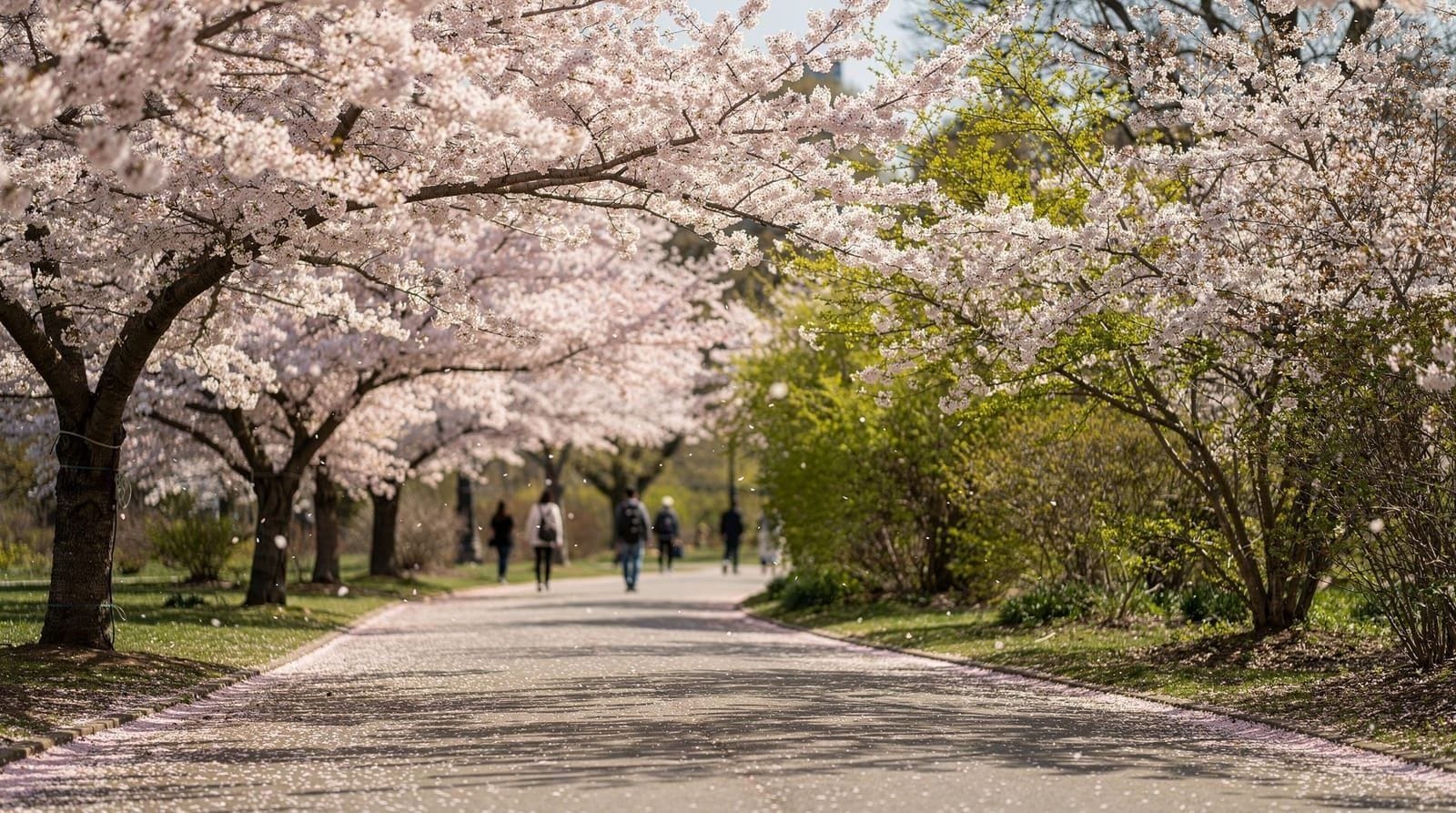
The densest cluster of trees sits around Hillside Gardens, close to High Park’s main entrances off Bloor Street West, with the trees arranged along a gently sloping hillside that creates natural sightlines for photos — both close-up shots of individual blossoms and wider shots capturing the full canopy against the sky. A smaller secondary cluster sits near Grenadier Pond, a short walk south, offering a quieter alternative with water reflections as a backdrop, generally with noticeably fewer people than the main Hillside grove.
Arriving early — ideally before 9am on weekends, or any weekday morning — makes a genuine difference. By midday on a peak Saturday or Sunday, the main grove is shoulder-to-shoulder with photographers, and finding a clear shot without other visitors in frame becomes difficult. Weekday visits, even at peak bloom, tend to be dramatically calmer.
What else is blooming
Cherry blossoms get the headline attention, but High Park’s broader spring bloom includes magnolias, daffodils, and a variety of other flowering trees and bulbs scattered throughout the park’s 400-plus acres, extending the park’s visual interest a few weeks beyond the cherry blossoms’ narrow window on either side. If your trip dates miss peak Sakura bloom by a few days, the park is still worth visiting for this broader spring show, and it avoids the cherry-blossom-specific crowds entirely.
Making a full visit of it
High Park is Toronto’s largest and most varied public park, and the cherry blossoms are really just one reason among several to visit. Grenadier Pond hosts a resident population of waterfowl and is a pleasant walk on its own. Colborne Lodge, a preserved 19th-century house museum near the park’s south end, offers a look at Toronto’s early colonial history. A small, free zoo near the park’s center houses bison, capybara, and a handful of other animals — modest by big-city zoo standards, but a nice add-on for families. In summer, the seasonal High Park miniature train offers rides through parts of the park’s interior.
Given the crowds during peak blossom weekends, it’s worth allocating separate time for the blossoms specifically (arrive early, see the trees, leave before the crowds peak) versus a longer, more relaxed exploration of the rest of the park on a different day or later in your visit — our Toronto with kids guide covers the park’s zoo and train ride if you’re visiting with children.
Getting there
High Park subway station on Line 2 sits at the park’s northeast corner, a short walk from the main Hillside Gardens cherry blossom cluster — the most direct and reliable way to reach the park, especially during peak bloom weekends when the city has, in past years, restricted vehicle access to some of the park’s interior roads to manage crowd volume. Driving in on a peak Saturday is generally not recommended; parking fills early and traffic around the park’s Bloor Street entrances backs up significantly.
Photography tips
Overcast days, somewhat counterintuitively, often produce better blossom photos than bright sunshine — the diffuse light reduces harsh shadows on the pale pink petals and avoids blown-out highlights. Early morning light, when available, adds a warm cast that works well against the blossoms. If you’re specifically chasing an empty-frame shot of the main grove, a weekday dawn visit is close to the only reliable way to get one during peak bloom.
Pairing it with the rest of your trip
High Park sits on the western edge of downtown, roughly 20 minutes from the core by subway, making it a reasonable half-day add-on rather than a full-day commitment if your trip is otherwise downtown-focused. For a broader look at the park’s hiking trails and layout beyond the blossom season, see our High Park trails guide.
If you’re specifically planning a spring trip around Toronto’s seasonal highlights, our Toronto in spring guide and cherry blossoms in Toronto guide both cover the broader window of flowering trees and events across the city beyond High Park alone. For help deciding whether spring is the right season for your trip overall, our best time to visit Toronto guide weighs it against summer, fall, and winter.
Hanami culture, in Toronto and in Japan
The tradition High Park’s cherry blossom season borrows from — hanami, literally “flower viewing” — has been practiced in Japan for over a thousand years, evolving from an aristocratic court custom into the broadly popular, egalitarian spring ritual it is today, where friends, families, and coworkers gather beneath blooming trees for picnics, drinks, and conversation rather than quiet, formal contemplation.
That distinction matters for setting expectations at High Park: this isn’t a hushed, meditative garden experience so much as a genuinely social one, closer in spirit to Japan’s own crowded, festive hanami parks during peak bloom than to a quiet botanical garden visit. The crowds, the photography, the general buzz of a lot of people gathered under the same trees at the same time, are part of the tradition rather than a distortion of it.
Toronto’s version is considerably smaller in scale than Japan’s major hanami sites — a few hundred trees in one grove, rather than the thousands lining entire rivers and parks across Japanese cities — but the underlying impulse is the same: a brief, deliberately impermanent natural spectacle that draws people outdoors specifically because it won’t last. The Japanese concept of mono no aware, a bittersweet awareness of the transience of beautiful things, is often cited as the emotional core of hanami, and it applies just as well to a Toronto visitor standing under the Hillside Gardens grove on a peak-bloom afternoon, aware that the same trees will be bare of blossoms again within a week.
The 1959 gift that established High Park’s grove sits within a broader, complicated history. Japanese-Canadians faced forced relocation, property seizure, and internment during the Second World War, a policy the Canadian government did not formally apologize for until decades later. The cherry tree gift, offered by the Japanese consul general in gratitude for how Toronto welcomed Japanese-Canadians in the years after that internment period ended, is best understood less as a simple thank-you gesture and more as part of a longer, harder process of rebuilding trust and community presence after a genuinely damaging chapter of state policy.
Toronto’s Japanese-Canadian community, though it never regained the population concentration it had before the war, has remained an active presence in the city since, and the High Park grove has become one of the more visible, ongoing symbols of that history — a fact that’s easy to miss amid the crowds and photography if you don’t already know the backstory.
Other North American cities, including Washington, D.C., whose Tidal Basin cherry trees are probably the continent’s most famous example, have their own histories of Japanese-gifted cherry groves, most originating from earlier 20th-century goodwill gestures unrelated to the wartime internment context specific to High Park’s trees. What sets Toronto’s grove apart within that broader pattern is precisely its postwar timing and the specific act of reconciliation it represented, rather than the more generic diplomatic friendship gestures behind many other North American plantings.
Visitors familiar with Washington’s cherry blossom season sometimes arrive expecting a similarly vast scale; High Park’s single concentrated grove is a genuinely different, more intimate experience by comparison, closer in feel to a single well-loved neighborhood park than a monumental civic landmark.
Toronto has, in recent years, added smaller cherry blossom plantings elsewhere in the city — scattered trees in other city parks and along some residential streets — partly in response to how crowded High Park’s peak weekends have become. None of these secondary spots comes close to matching the density or photogenic impact of the Hillside Gardens grove, but they’re worth knowing about as a low-key alternative if you’re in Toronto slightly outside the High Park peak window and want a smaller-scale blossom fix without the crowds, or if you’re simply staying somewhere across the city and don’t want to make the specific trip out to High Park’s western edge.
Practical notes
- Cost: Free — no admission fee for the park or the blossom viewing.
- Bathrooms: Public facilities are available near the park’s main entrances and visitor areas.
- Weather: Spring weather in Toronto is genuinely variable — layer up, since a blossom-viewing morning can swing from chilly to warm within the same visit.
- Accessibility: Paved paths connect the main entrances to Hillside Gardens; some of the sloped grove areas are less consistent for wheelchairs.
The honest advice for High Park’s cherry blossoms is to stay flexible on dates rather than locking in a fixed day months ahead — track the blossom-watch updates in the final week before your trip, and if you can, keep a backup day open in case the bloom runs early or late.
If your Toronto dates don’t line up with peak bloom
Because the window is so short and shifts by weeks year to year, plenty of visitors land in Toronto a few days too early or too late. If that happens, don’t treat the trip as a wash — the park’s magnolias and daffodils extend the flowering show on either side of the cherry peak, and High Park itself, covered fully in our High Park trails guide, is worth a visit regardless of what’s blooming. For a broader sense of whether spring is the right season for your trip at all, weighed against summer, fall and winter, see best time to visit Toronto.
Frequently asked questions about High Park’s cherry blossoms
Where in High Park are the cherry blossoms?
The main concentration is around Hillside Gardens and the area near Grenadier Pond, close to the park’s Bloor Street entrances. This cluster of roughly 700 Somei-Yoshino cherry trees is the park’s signature bloom, though scattered trees appear elsewhere in the park too.
How did High Park get its cherry trees?
The original trees were a gift from the Japanese consul general in 1959 in gratitude for Toronto’s welcome of Japanese-Canadians after the Second World War internment period. The city added more trees in later decades, including a further donation, expanding the original planting into today’s larger grove.
Is High Park cherry blossom season crowded?
Yes, extremely, on weekends during the peak few days — it draws large crowds for photos, and popular tree clusters get genuinely packed. Weekday mornings offer a dramatically calmer experience for the same bloom, and arriving before 9am makes a real difference even on a weekend.
Is it free to see the cherry blossoms in High Park?
Yes, High Park is a free public park with no admission fee at any time of year, including during blossom season and for every other part of the park’s 400-plus acres.
What happens if I miss peak bloom in High Park?
The blossoms typically last a week to ten days total from first bud to petal drop, with only two or three days at true peak. If you miss the peak, the park itself and its other spring blooms — magnolias, daffodils — are still worth visiting, and Toronto’s other green spaces offer alternative spring color.
How do you get to High Park for cherry blossom season?
High Park subway station on Line 2 sits at the park’s northeast corner, a short walk from the main cherry blossom viewing area. During peak bloom weekends, the city sometimes restricts vehicle access to the park’s interior roads to manage crowds, so transit is the more reliable option.