Niagara Escarpment Trail guide
What is the Niagara Escarpment Trail?
It refers to the southernmost stretch of the Bruce Trail, Canada's oldest and longest marked footpath, which begins at Queenston near Niagara-on-the-Lake and runs the length of the Niagara Escarpment. In the Niagara region specifically, it links a string of conservation areas — Ball's Falls, Louth, Beamer Memorial, Rockway — each with its own short loop trails off the main through-route.
A 900-kilometre trail that starts at the falls
The Bruce Trail is Canada’s oldest and longest continuously marked footpath, running roughly 900 km from Queenston Heights near Niagara-on-the-Lake to Tobermory at the tip of the Bruce Peninsula, tracing the Niagara Escarpment — a long limestone ridge that also happens to be the geological feature responsible for Niagara Falls itself. What most visitors mean by the “Niagara Escarpment Trail” is the southern end of this route, the section running through the Niagara wine region between St. Catharines and Grimsby, where the main trail links a chain of conservation areas each offering their own manageable loop hikes without requiring a multi-day thru-hike.
| Where | St. Catharines to Grimsby, southern Niagara wine region |
| Cost | Around CAD $8-12 day-use fee per conservation area |
| Best hike | Ball’s Falls, 3-4 km loop, 1.5-2 hours |
| Getting there | Car essential — no public transit between sites |
| Pairs with | Niagara wine country tastings |
Understanding the Bruce Trail’s markings
The main Bruce Trail is marked with white rectangular blazes painted on trees and posts; side trails looping off the main route use blue blazes. This matters practically — most day visitors aren’t hiking the full through-route but rather a conservation area’s blue-blazed side loop that connects briefly to the white-blazed main trail. Trail maps at each conservation area’s parking lot clarify which loop is which, and the Bruce Trail Conservancy (the nonprofit that maintains and protects the trail corridor) publishes detailed maps for anyone hiking longer sections.
Ball’s Falls Conservation Area
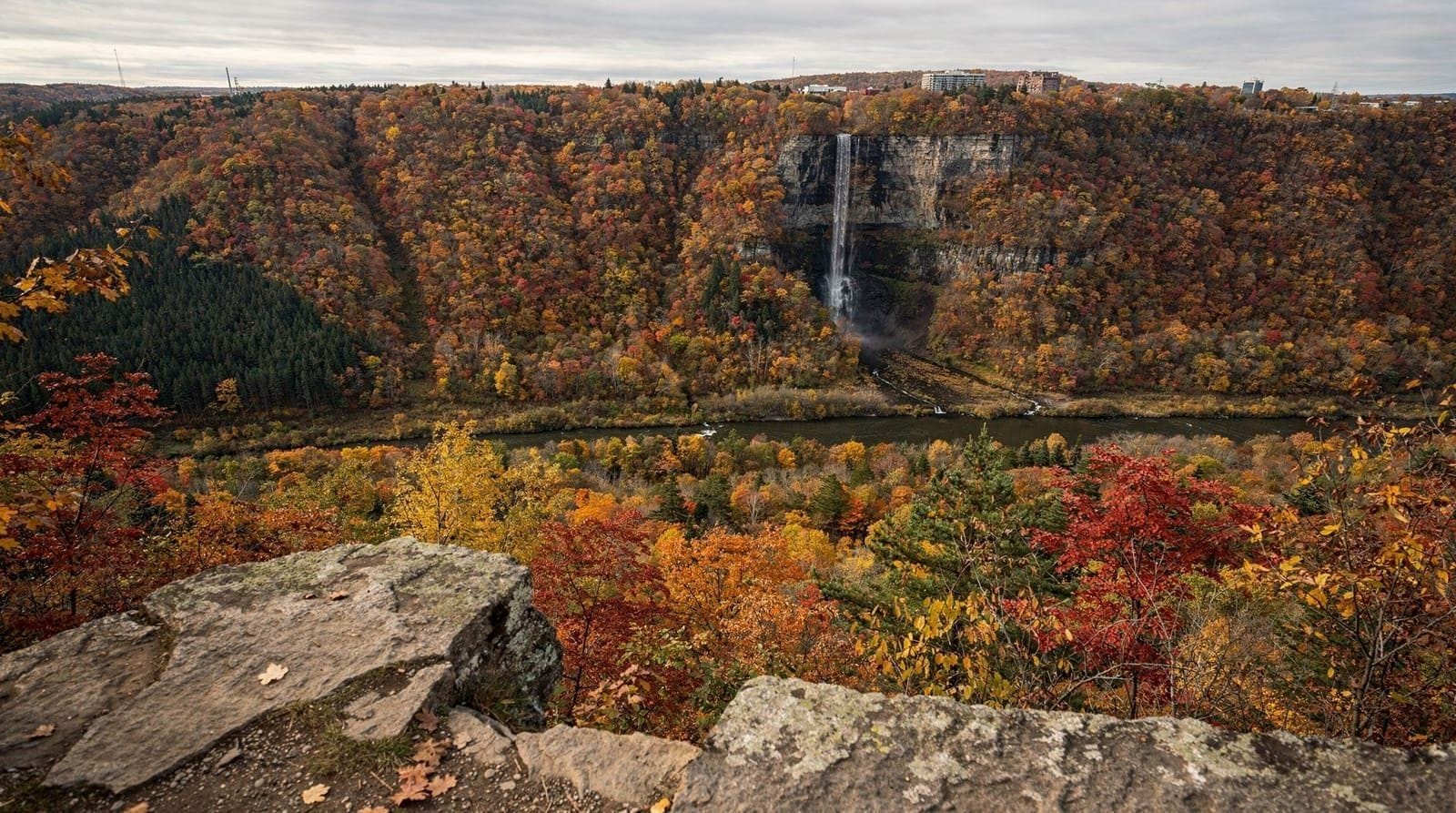
Ball’s Falls, near Jordan in the heart of Niagara wine country, is probably the best-known stop on this stretch — twin waterfalls (Upper and Lower Ball’s Falls) set within a Niagara Peninsula Conservation Authority property that also preserves a 19th-century mill village. The main loop trail is a moderate 3-4 km covering both falls and the historic buildings, manageable in 1.5-2 hours. It gets busy on weekends, particularly during the conservation area’s occasional heritage events, so an early start helps.
Beamer Memorial Conservation Area — the hawk-watching lookout
Beamer Memorial, near Grimsby, sits at the escarpment’s edge with sweeping views over Lake Ontario and is one of the best-known hawk-migration watchpoints in Ontario. Each spring, thousands of raptors funnel along the escarpment updrafts here on their northward migration, drawing birders with scopes and cameras during peak weeks (typically March into April). Outside migration season it’s still a worthwhile short hike for the views alone — the main loop is under 3 km with minimal elevation change once you’re at the top.
Louth and Rockway Conservation Areas
Louth Conservation Area, closer to St. Catharines, offers a quieter, less-visited stretch of the escarpment trail through mixed forest, with a small waterfall as the main destination. Rockway Conservation Area, similarly low-key, connects into the same section of the Bruce Trail and is a reasonable choice if Ball’s Falls’ parking lot is full — a common weekend problem at the more popular sites.
Niagara Glen — a different kind of escarpment trail
Distinct from the Bruce Trail proper but part of the same escarpment geology, Niagara Glen Nature Reserve sits along the Niagara River gorge itself, a few kilometres upstream from the falls. Its network of trails (Cave, Woodland, River, and Cliff, among others) descends into the gorge on steep, sometimes uneven stone stairs and natural rock terrain — genuinely more rugged than the conservation-area loops further along the escarpment, and worth a stop if you’re already visiting Niagara Falls and want a hiking break from the tourist strip. Sturdy footwear is a real requirement here, not just a suggestion — the rock surfaces get slick when wet.
Twenty Valley and Short Hills — lesser-known stretches
Further along the escarpment toward the Welland area, Short Hills Provincial Park offers a quieter, more forested hiking network with several loop options through the Twenty Mile Creek valley, a landscape of rolling hills and hardwood forest distinct from the cliff-edge character of the Ball’s Falls and Beamer stretch.
It sees noticeably less traffic than the more famous conservation areas closer to the QEW, making it a reasonable choice if you’re looking for a quieter escarpment hike without the weekend crowds. The “Twenty Valley” name locally also refers to the surrounding wine region, since Twenty Mile Creek and its watershed roughly define much of Niagara’s wine country geography — a useful landmark if you’re combining a hike with winery visits.
Trail etiquette and the Bruce Trail Conservancy
The Bruce Trail Conservancy, the nonprofit responsible for maintaining and protecting the trail corridor, relies heavily on a network of volunteer landowners who allow the trail to cross private property along much of its route — a detail that makes staying strictly on the marked path more than just a courtesy, since off-trail wandering risks landowner access being revoked for everyone. Membership in the Bruce Trail Conservancy supports trail maintenance and grants access to detailed printed maps covering the full 900 km route, useful for anyone planning to hike beyond the day-trip sections covered in this guide.
Combining the escarpment with Niagara wine country
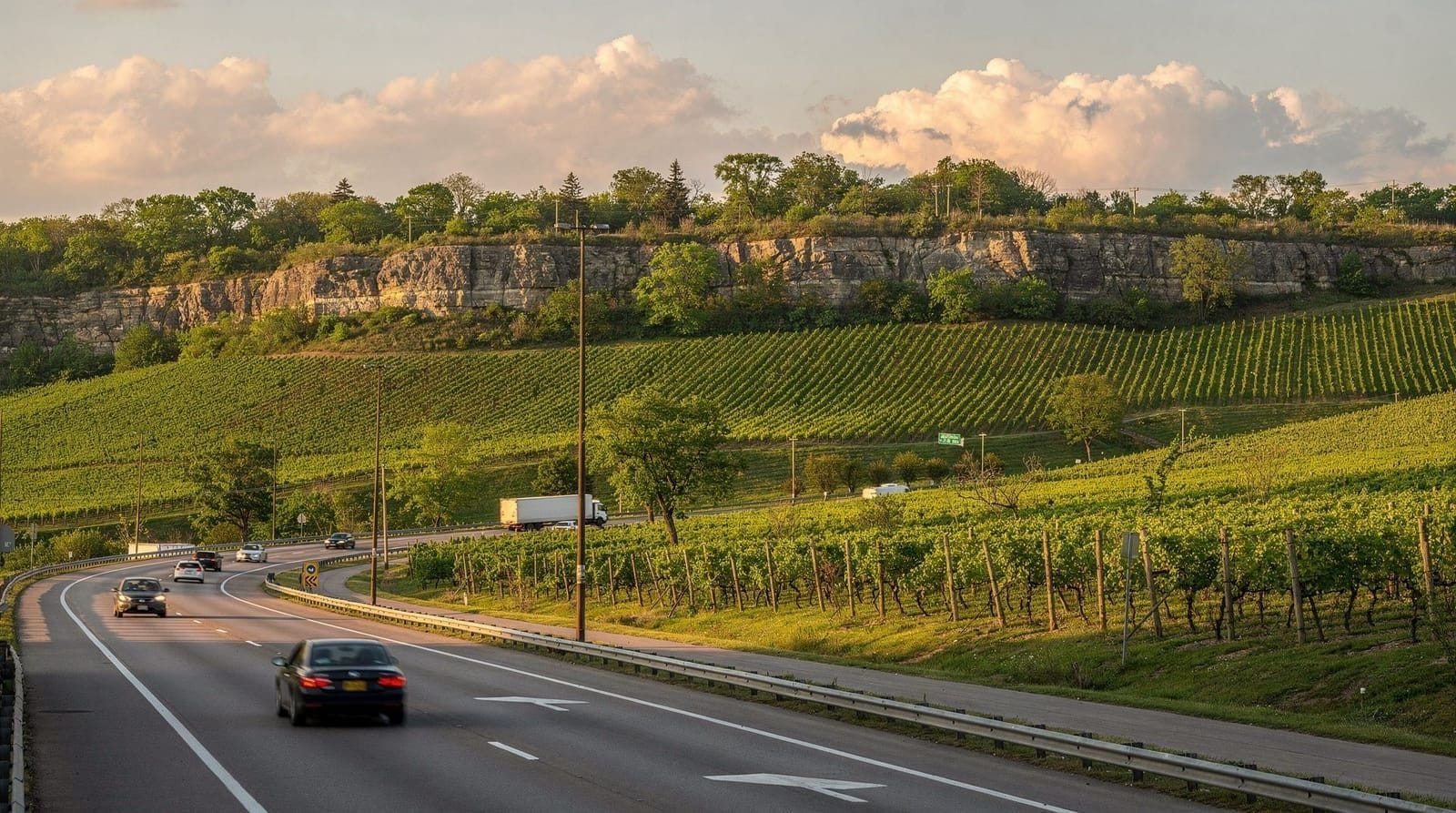
Because the Bruce Trail’s Niagara section runs directly through the heart of Niagara’s wine region, pairing a morning hike at Ball’s Falls or Beamer Memorial with an afternoon of winery visits is one of the more natural itinerary combinations in the area — the escarpment’s elevation and drainage are, in fact, part of why this specific stretch produces the microclimate that makes Niagara wine country viable in the first place. See the Niagara wine country guide for wineries clustered near these same trailheads.
Niagara half-day winery tour and tastingsIf you’d rather have the wine pairing handled for you after a self-guided morning hike, a guided half-day winery tour picks up where the trail leaves off without requiring you to plan tasting-room logistics yourself.
Planning a day along the escarpment
Because these conservation areas are spread out over roughly 30-40 km of the escarpment’s southern stretch, visiting more than two or three in a single day means a fair amount of driving between stops rather than continuous hiking. A reasonable day plan pairs Ball’s Falls with either Beamer Memorial or Niagara Glen, depending on whether you’re prioritizing waterfalls-and-history or gorge scenery. None of these sites are reachable by public transit in a practical way — a car is necessary for this whole stretch of the escarpment.
The escarpment as a UNESCO biosphere reserve
The Niagara Escarpment holds UNESCO World Biosphere Reserve status, recognizing it as a globally significant landscape balancing conservation with the surrounding agricultural and residential land use — one of relatively few such designations in Ontario, and part of why the corridor of conservation areas covered in this guide has been so consistently protected from development over the decades, unlike much of the rapidly urbanizing land nearby.
Fees and seasonal notes
Most Niagara Peninsula Conservation Authority properties (Ball’s Falls, Louth, Rockway) charge a modest day-use parking or admission fee, typically in the CAD $8-12 range depending on the site. Beamer Memorial is managed by the Niagara Peninsula Conservation Authority as well and follows similar fee structures during peak season. Trails here stay open year-round, though winter conditions on the steeper sections (particularly Niagara Glen’s stone stairs) can be genuinely hazardous with ice — microspikes are worth carrying if hiking between December and March.
For the broader Niagara region beyond hiking, see Niagara Falls day trip from Toronto and Niagara-on-the-Lake day trip. If you’re combining an escarpment hike with wine country, Niagara wine country guide covers the wineries clustered along the same stretch of the escarpment. And for the escarpment’s other well-known hiking cluster near Hamilton, see the Dundas Peak Hamilton hiking guide.
Frequently asked questions about the Niagara Escarpment Trail
Is the Niagara Escarpment Trail the same as the Bruce Trail?
The Niagara Escarpment Trail generally refers to the southern end of the Bruce Trail, which begins at Queenston near Niagara-on-the-Lake. The Bruce Trail itself continues roughly 900 km north to Tobermory, but most day visitors are hiking one of the shorter conservation-area loops that branch off this southern section rather than the full through-route.
Do I need to pay to hike Ball’s Falls?
Yes, Ball’s Falls Conservation Area charges a day-use admission fee, typically CAD $8-12, which covers parking and trail access to both waterfalls and the historic mill village.
What is the best time to visit Beamer Memorial Conservation Area for hawk watching?
Peak spring hawk migration typically runs from mid-March into April, when thousands of raptors pass along the escarpment updrafts. Outside this window, it’s still a worthwhile short hike for the Lake Ontario views.
Is Niagara Glen difficult to hike?
Yes, relative to the other escarpment trails in this guide — the descent into the Niagara River gorge involves steep, sometimes uneven stone stairs and natural rock terrain, and gets slick when wet. It’s manageable for most reasonably fit hikers but is a step up in difficulty from the conservation-area loops.
Can I hike the Niagara Escarpment Trail without a car?
Not practically. The conservation areas covered here (Ball’s Falls, Beamer Memorial, Louth, Rockway) are spread across roughly 30-40 km with no public transit connections, so a car is essential for visiting more than one site in a day.
Is the escarpment trail open in winter?
Yes, most sections stay open year-round, but steeper stretches like Niagara Glen’s stone stairs can ice over and become genuinely hazardous between December and March — microspikes are a worthwhile addition to winter hiking gear here.
Do I need to stay on the marked trail along the Bruce Trail?
Yes, strictly — much of the route crosses private land through agreements with individual landowners, and off-trail wandering risks that access being revoked for the entire trail network, not just the section in question.
Is Short Hills Provincial Park worth visiting over Ball’s Falls?
It depends on your priority — Short Hills offers a quieter, more forested hiking experience with fewer crowds, while Ball’s Falls delivers the more dramatic waterfall-and-history combination but draws heavier weekend traffic.
Can I combine an escarpment hike with a winery visit in the same day?
Yes, easily — most of these conservation areas sit directly within or beside Niagara wine country, so a morning hike followed by an afternoon of tastings is one of the most natural itinerary pairings in the region.