Guide to Queen West
Hidden Toronto City Walking Tour
What is Queen West known for?
Queen West is Toronto's arts, fashion, and nightlife strip running along Queen Street West from Spadina Avenue to Gladstone Avenue, anchored by Trinity Bellwoods Park and the boutique Drake and Gladstone Hotels. It's the closest Toronto gets to a single continuous 'creative district,' mixing independent galleries, vintage and designer fashion, and one of the city's densest concentrations of bars.
Toronto’s longest-running creative strip
Queen Street West has been Toronto’s arts and fashion corridor for longer than most of the city’s other “hip” neighborhoods have existed — it was drawing musicians, designers, and gallery owners as far back as the 1980s, well before Ossington or the Junction picked up similar reputations. What makes it distinct from a lot of gentrified arts districts elsewhere is that it never fully consolidated into a single polished brand; walking its length still mixes independent boutiques, longstanding dive bars, design studios, and newer high-end retail in a way that feels layered rather than curated.
| Where | Queen Street West, from Spadina Avenue to Gladstone Avenue |
| Cost | Free to walk; around $15–20 CAD for a casual meal, $12–16 CAD for a cocktail |
| Time needed | 2–3 hours for a browsing walk, longer with dinner or a night out |
| Getting there | 501 Queen streetcar end to end, or Osgoode subway station at the eastern edge |
| Best time | Warm-weather weekends for Trinity Bellwoods, weeknights for a quieter walk |
The strip runs roughly from Spadina Avenue in the east to Gladstone Avenue in the west, a walk of about 2 kilometers that most visitors break into a loop with a stop in Trinity Bellwoods Park at the midpoint.
The eastern stretch
Closer to Spadina, Queen West carries more of the flagship fashion and streetwear retail — a mix of Canadian and international brands, several multi-floor concept stores, and a noticeably younger, trend-forward crowd than you’ll find in Yorkville’s more traditional luxury retail. This end also has the highest concentration of the strip’s bars and late-night food spots, making it the busiest section after dark.
Trinity Bellwoods Park
About halfway along the strip, Trinity Bellwoods is one of Toronto’s most heavily used parks — a wide, open green space that, on any warm weekend, fills with picnic blankets, dog walkers (there’s a large off-leash dog bowl in the park’s south end that’s become a bit of a neighborhood landmark), and informal gatherings that spill out from nearby patios. It’s a good midpoint break on a Queen West walk and a genuinely representative slice of how locals actually use their parks, rather than a manicured tourist green space.
West Queen West and the gallery stretch
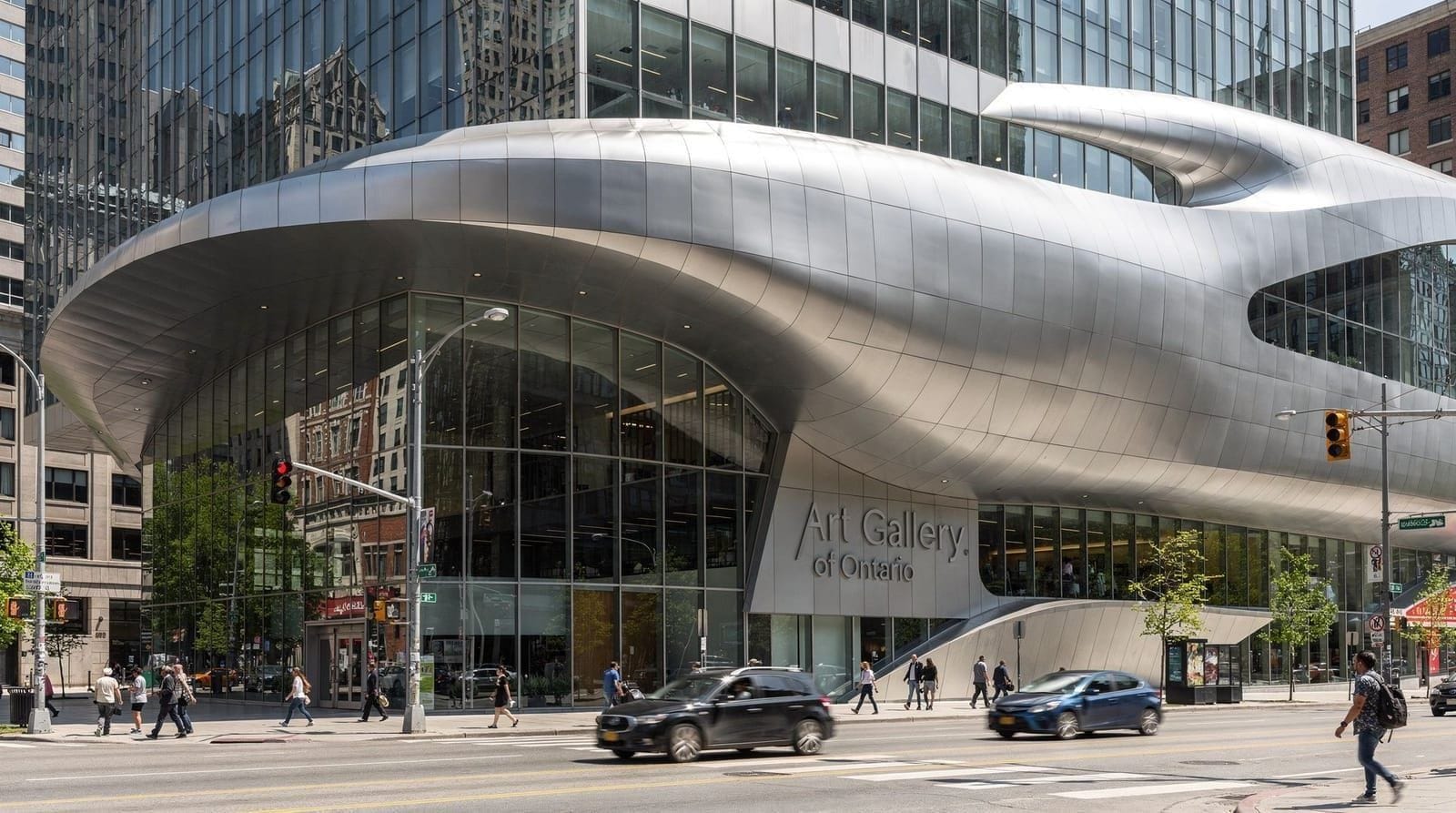
Past Bathurst Street, the strip shifts noticeably — fewer chain-adjacent fashion stores, more independent galleries, design studios, and furniture showrooms. This section, sometimes marketed separately as “West Queen West,” was named one of the coolest neighborhoods in the world by multiple international publications through the 2010s, and while some of that specific buzz has cooled, the gallery density remains real. It’s a slower, more browsing-oriented stretch than the eastern end, and a natural pairing with the Art Gallery of Ontario if contemporary art is a priority on your trip.
The Drake and the Gladstone
Two boutique hotels anchor the neighborhood’s cultural identity well beyond their guest rooms. The Drake Hotel functions as much as a nightlife and events venue as a place to sleep — a restaurant, a rooftop patio (Sky Yard) with skyline views, and a basement performance space that regularly hosts live music, comedy, and DJ nights open to non-guests. The Gladstone Hotel, a few blocks west and Toronto’s oldest continuously operating hotel building, leans harder into visual art — its rooms have historically been individually designed by different local artists, and its lobby and ground-floor galleries host rotating exhibitions and events. Both are worth a stop even if you’re staying elsewhere.
Seeing the neighborhood with local context
Queen West’s layered history — punk clubs that became galleries, warehouses that became lofts, the parts of the strip that gentrified fast and the parts that didn’t — is easy to walk past without noticing if you don’t know where to look. The Hidden Toronto city walking tour covers some of this ground with a guide pointing out the less obvious history behind storefronts that look unremarkable from the sidewalk, useful if you want more context than a self-guided wander provides.
Eating and drinking
Queen West’s food scene runs from cheap late-night slice shops to genuinely destination-level restaurants, often within a block of each other. It’s also one of the best neighborhoods in the city for a proper bar crawl, with a dense cluster of cocktail bars, breweries, and dive bars that don’t require much planning — walking the strip on a Friday or Saturday night and picking whatever looks busy is a reasonably reliable strategy. Expect $15-20 CAD ($11-15 USD) for a casual meal and $12-16 CAD ($9-12 USD) for a cocktail at most of the strip’s bars, roughly in line with downtown Toronto averages.
Getting there
The 501 Queen streetcar runs the entire length of the neighborhood and is the most direct way to reach any point along the strip from downtown. Osgoode station on Line 1 puts you at the eastern edge near Spadina, a comfortable starting point if you want to walk the full length west toward Trinity Bellwoods and beyond. Street parking is metered and competitive on weekends; several paid lots exist along side streets if you’re driving in.
When to go
Queen West works year-round given its mix of indoor shopping and dining, but it’s most alive on warm-weather weekends when Trinity Bellwoods fills and patio seating opens up along the strip. Weeknight evenings offer a quieter, easier-to-navigate version if crowds aren’t your preference. The neighborhood also sees a noticeable bump during TIFF, when several venues along the strip host festival-adjacent events — see our TIFF Toronto guide for more on how festival week reshapes the city’s nightlife map.
Pairing it with the rest of your trip
Queen West connects naturally to Kensington Market at its eastern end — the two neighborhoods sit close enough that a combined afternoon walk is common, moving from Queen West’s fashion-and-gallery strip into Kensington’s food-and-vintage density. If you’re building a longer downtown route, our downtown Toronto walking guide includes Queen West as one leg of a broader loop through the Financial District and Chinatown.
Travelers deciding where to base their stay should also weigh Queen West against other options in our best Toronto neighborhoods to stay guide — it’s a strong pick for nightlife-focused visitors, less ideal if you want to be walking distance from the CN Tower or the Financial District’s core sights.
The strip’s punk and new-wave roots
Queen West’s reputation as an arts corridor didn’t start with the boutique hotels or the galleries that dominate it now — it started in the late 1970s and 1980s with a wave of punk and new-wave musicians and visual artists who moved into the area specifically because the rent was cheap and the old warehouse and retail spaces along the strip offered exactly the kind of raw, unrenovated space that cheap studios and DIY venues need. The Rivoli, opened in 1982, became the scene’s central venue — a narrow restaurant-bar-performance space that hosted early shows by Canadian acts on their way up alongside touring American indie bands, with a back-room pool hall that doubled as an informal industry hangout.
The Cameron House, a few blocks west, developed a parallel reputation for hosting the city’s roots-rock and alt-country scene through the 1980s and 90s, and its exterior murals — giant sculptural legs protruding from the upper facade — became one of the strip’s most recognizable landmarks. A cluster of artist-run galleries and collectives active through the early-to-mid 1980s gave the neighborhood its early reputation as a serious contemporary art scene rather than just a nightlife strip, predating the more commercial gallery wave that followed decades later in West Queen West.
Citytv, the scrappy, street-level television station founded by Moses Znaimer, also anchored itself near Queen and John Streets in this era, with street-facing studios that let pedestrians watch broadcasts happening live through the windows — an unusually literal expression of the neighborhood’s blurred line between public street life and creative production. That combination of cheap studio space, a handful of committed venues, and a broadcaster willing to put its cameras at street level gave Queen West a documented, self-reinforcing identity as Toronto’s creative corridor well before international press started writing about West Queen West’s gallery boom in the 2000s and 2010s.
Much of that original scene has since been priced out — rents along the strip climbed steadily from the 1990s onward as the neighborhood’s reputation attracted higher-end retail — but venues like the Rivoli and the Cameron House still operate today, giving Queen West one of the few Toronto arts corridors where you can still visit the actual rooms where the scene’s founding chapter happened, rather than just reading a plaque about them.
West of the retail strip, Queen Street West carries a very different kind of history connected to Toronto’s mental health care system. The Centre for Addiction and Mental Health (CAMH) occupies a large campus along this stretch, built on the site of the former Provincial Lunatic Asylum, an institution that opened in 1850 and became so identified with the address that “999 Queen Street” became local shorthand for institutionalization for much of the 20th century.
A section of the original 1860s perimeter wall — tall, rough-cut stone, built partly to keep the institution visually separated from the surrounding city — still stands today, preserved as a heritage structure even as CAMH redeveloped much of its campus in recent decades into a more open, street-level design intended to reduce stigma rather than reinforce it. It’s a stretch of the strip most tourist itineraries skip entirely, but it’s a significant piece of the neighborhood’s actual history.
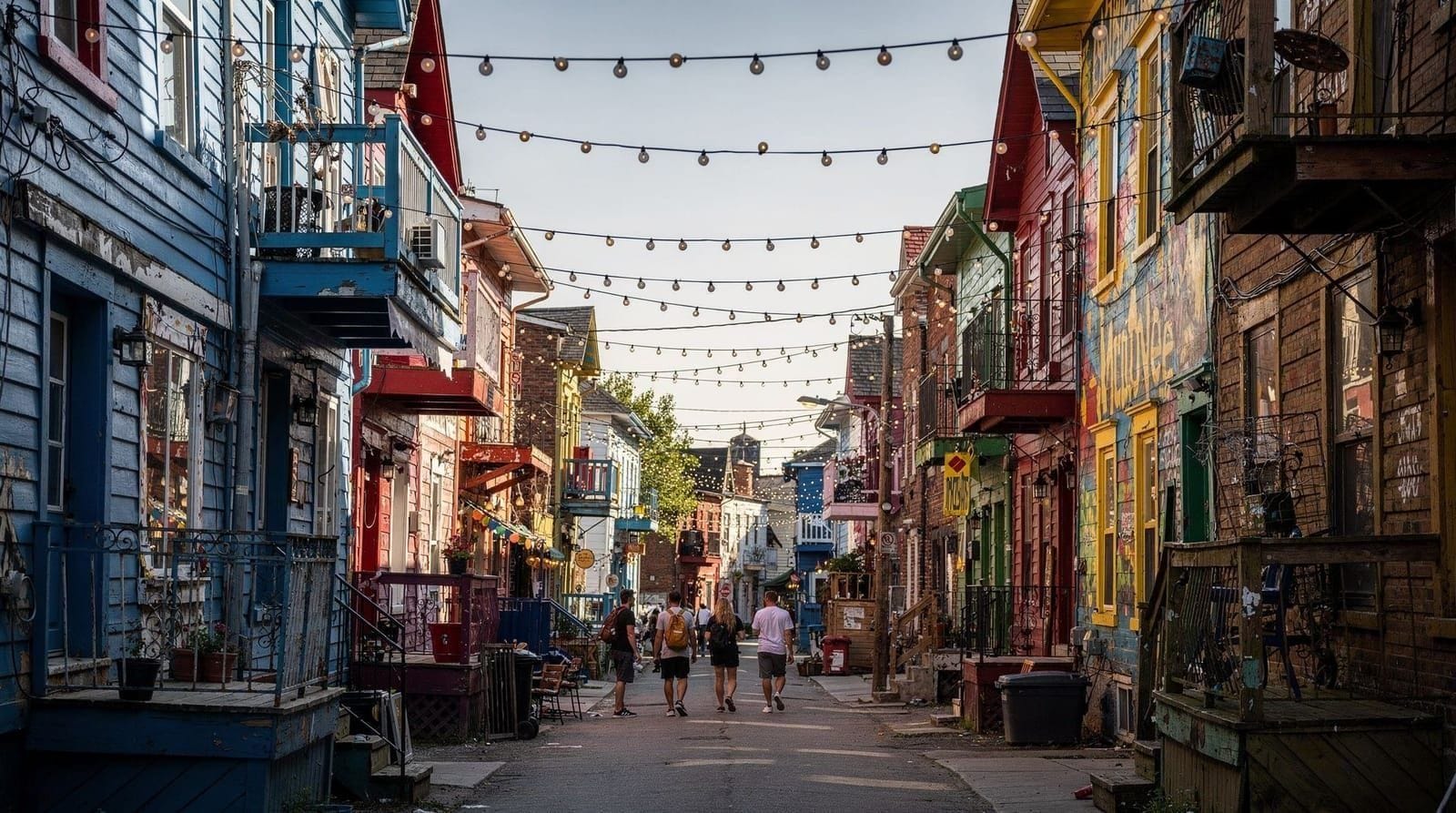
A block south of the main strip, Rush Lane — better known locally as Graffiti Alley — runs behind the Queen West storefronts as a long, constantly repainted corridor of legal street art. Local and touring artists have used the alley for decades, and because the murals are legal and expected to change, nothing here is permanent; a wall painted one month might be entirely different by the next visit.
It gained wider recognition after the Canadian band Rush used the alley as the setting for a music video, and it’s a reliable spot to see large-scale, high-quality street art without hunting across multiple neighborhoods. It’s an easy five-minute detour off Queen Street West itself, and unlike the more curated gallery spaces along the strip, it costs nothing and requires no appointment.
Practical notes
- Cost: Walking the strip is free; expect standard downtown Toronto pricing for food, drinks, and shopping.
- Accessibility: Sidewalks are wide and mostly modern along the main strip; some of the older storefronts have a step at the entrance.
- Bathrooms: Available in cafés, bars, and restaurants for customers; public facilities exist within Trinity Bellwoods Park.
- Noise: The eastern end near Spadina is loud late into weekend nights — a consideration if you’re staying at a hotel directly on the strip and prefer quiet.
Queen West rewards an unhurried walk more than a checklist of specific stops — start at one end, let Trinity Bellwoods break up the middle, and see what’s actually open and busy rather than chasing a pre-picked list of shops.
Shopping along the strip, section by section
If shopping is your main goal rather than just browsing, it helps to know which stretch matches what you’re after. Near Spadina, expect flagship streetwear and concept stores aimed at a younger, trend-driven crowd. Between Bathurst and Trinity Bellwoods, independent boutiques and Canadian designer labels dominate, with prices that vary widely from accessible to genuinely high-end.
Past Trinity Bellwoods into West Queen West, the focus shifts to design studios, furniture and home-goods showrooms, and the galleries themselves — this stretch is better for looking than buying unless you have a specific piece in mind. Vintage shoppers should note that Queen West’s vintage selection is thinner and pricier than Kensington Market’s; if that’s your priority, budget time for both rather than expecting Queen West to cover it.
A one-afternoon walking route
Start at Osgoode station and walk west, browsing the eastern retail stretch before it gets too crowded. Stop for a coffee or an early lunch around the midpoint, then spend 30–45 minutes in Trinity Bellwoods Park if the weather cooperates — it’s the natural halfway break and a good spot to sit rather than keep walking. Continue into West Queen West for the gallery stretch, popping into whichever storefronts look open and interesting rather than trying to hit every listed gallery. If you have energy left, Rush Lane (Graffiti Alley) is a five-minute detour south of the strip near Portland Street, and a strong way to close out the walk before heading back downtown or continuing on to Kensington Market.
Toronto downtown 2-hour guided walking tourFrequently asked questions about Queen West
How do you get to Queen West?
The 501 Queen streetcar runs the length of the strip and is the simplest way to get there from downtown. Osgoode subway station on Line 1 puts you at the eastern end near Spadina, a short walk from the neighborhood’s start.
Is Queen West safe at night?
Yes, it’s one of Toronto’s busiest nightlife strips and well-populated late into the evening on weekends. Standard city awareness applies, particularly around closing time when bar crowds spill onto the sidewalks.
What’s the difference between Queen West and West Queen West?
Queen West typically refers to the stretch from Spadina to Bathurst, historically fashion and nightlife focused. West Queen West extends further, from Bathurst to Gladstone Avenue and beyond, and leans more toward galleries and design studios, though most visitors treat it as one continuous walk.
Is Trinity Bellwoods Park worth visiting?
Yes, it’s one of Toronto’s most-used green spaces, especially on weekends when it fills with picnics, dog walkers, and impromptu gatherings. It’s a good midpoint break if you’re walking the full length of Queen West.
How much time should I budget for Queen West?
Two to three hours for a browsing walk covering the main strip and Trinity Bellwoods. Add more if you’re planning dinner or a night out at one of the neighborhood’s bars.
Are the Drake and Gladstone Hotels worth visiting if I’m not staying there?
Yes, both operate as cultural hubs beyond their hotel rooms — the Drake Hotel has a rooftop patio, restaurant, and regular live music and events open to the public, and the Gladstone Hotel hosts rotating art exhibitions and a lobby bar worth a stop even for non-guests.
Is Queen West walkable in one go, or should I split it up?
Most visitors do it as one continuous walk with a break at Trinity Bellwoods, since the full strip is only about 2 kilometers. Splitting it across two visits makes sense if you want to linger longer in the galleries or do a proper night out separately from daytime shopping.
How does Queen West compare to Ossington for nightlife?
Queen West has a denser, more varied concentration of bars along a single continuous strip, while Ossington (a short walk or streetcar ride away) offers a smaller, more curated cluster of cocktail bars and restaurants. Both are reasonable choices for an evening out; Queen West is the easier one to reach directly by streetcar.
Top experiences
Bookable activities with verified prices and instant confirmation on GetYourGuide.