Guide to the Distillery District
Distillery District Historic Walking Tour
What is the Distillery District known for?
The Distillery District is a car-free, cobblestoned historic district built around the former Gooderham & Worts distillery — once the largest whisky distillery in the British Empire. Today its red-brick Victorian buildings house art galleries, boutique shops, restaurants, and Mill Street Brewery, and the site is frequently used as a film set.
A whisky empire turned pedestrian village
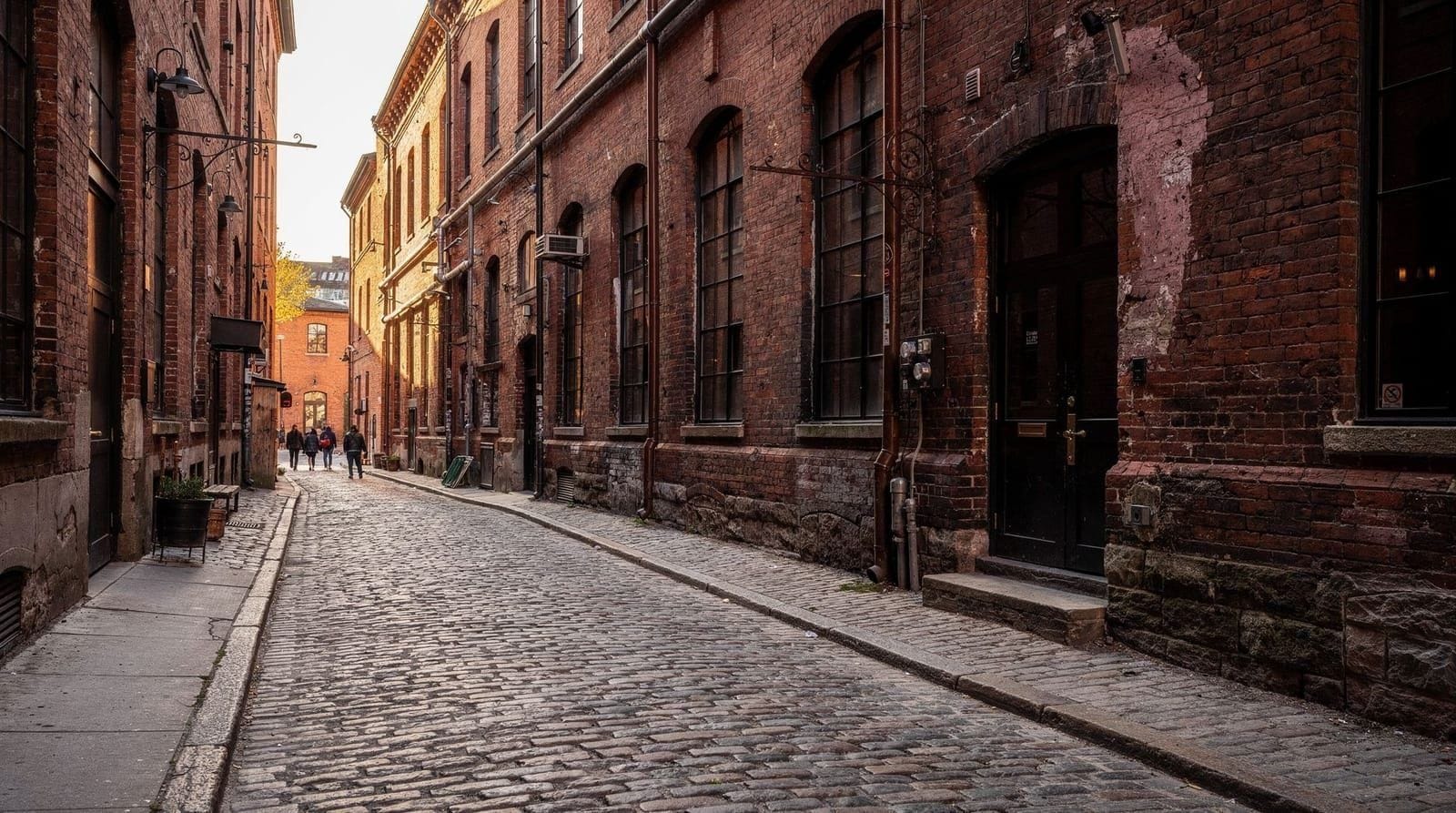
In 1832, the Gooderham & Worts distillery began producing spirits on this stretch of land east of downtown Toronto, and by the late 1800s it had grown into the largest distillery in the British Empire. Prohibition and shifting industry eventually shut it down, and the 13-acre site sat mostly dormant for decades — which, unintentionally, is why it survived. Because nobody redeveloped it, more than 40 Victorian industrial buildings remain standing, forming the largest and best-preserved collection of Victorian-era industrial architecture in North America. The site reopened as a pedestrian-only arts and entertainment district in 2003, and it’s stayed largely car-free ever since.
That preservation is the whole draw. Unlike most “historic district” branding in North American cities — a couple of restored facades next to a parking garage — the Distillery District is genuinely a full intact industrial complex you can walk through uninterrupted, cobblestones and all.
| Where | Southeast of downtown, bordered by Parliament, Mill, and Cherry Streets |
| Cost | Free to walk; around $30–50 CAD per person for a sit-down meal |
| Time needed | 90 minutes for a relaxed walk, half a day with a meal and galleries |
| Getting there | 20 min walk from Union Station, or 504 King streetcar to Parliament Street |
| Best time | Weekday mornings for photos, Nov–Dec for the Christmas Market |
What’s actually inside
The district is organized into a grid of pedestrian lanes lined with red-brick warehouses, most now split into small units. A few anchors worth knowing before you go:
- Mill Street Brewery: One of Toronto’s original craft breweries, brewing on-site since 2002. The taproom does flights and a full pub menu, and it’s the most reliable spot for a sit-down beer in the district — see our best breweries in Toronto guide for how it compares to the rest of the city’s craft beer scene.
- Corkin Gallery: A serious contemporary art and photography gallery inside one of the largest original buildings — worth a stop even if you’re not usually a gallery person.
- SOMA Chocolatemaker and Cacao 70: Two very different chocolate experiences a few doors apart — SOMA does bean-to-bar craft chocolate with tastings, Cacao 70 leans into elaborate milkshakes and dessert theatrics.
- Balzac’s Coffee: The original location of this now-regional coffee chain, set inside a converted boiler house with a soaring ceiling — one of the better-looking cafés in the city.
- Young Centre for the Performing Arts: Home to Soulpepper Theatre Company, staging a rotating season of plays and musicals in a converted tank house.
Most of the retail leans toward independent design, jewelry, and home goods rather than souvenir shops — Bergo Designs and a handful of small studios sell locally made ceramics and jewelry that make better gifts than anything at a mall kiosk.
Walking the district with context
The architecture tells a story if you know what you’re looking at — which building was the original rack house, which chimney marks the boiler plant, why the streets are cobblestone rather than paved. The Distillery District historic walking tour covers that history in about 90 minutes with a guide who can point out details — old rail spurs, brick stamps, film-shoot trivia — that are easy to miss walking through on your own.
If you’d rather explore independently, free printed maps are available at the visitor information kiosk near the main entrance on Trinity Street, and most of the original building signage (converted from distillery-era function names) is still legible if you look up.
Eating and drinking
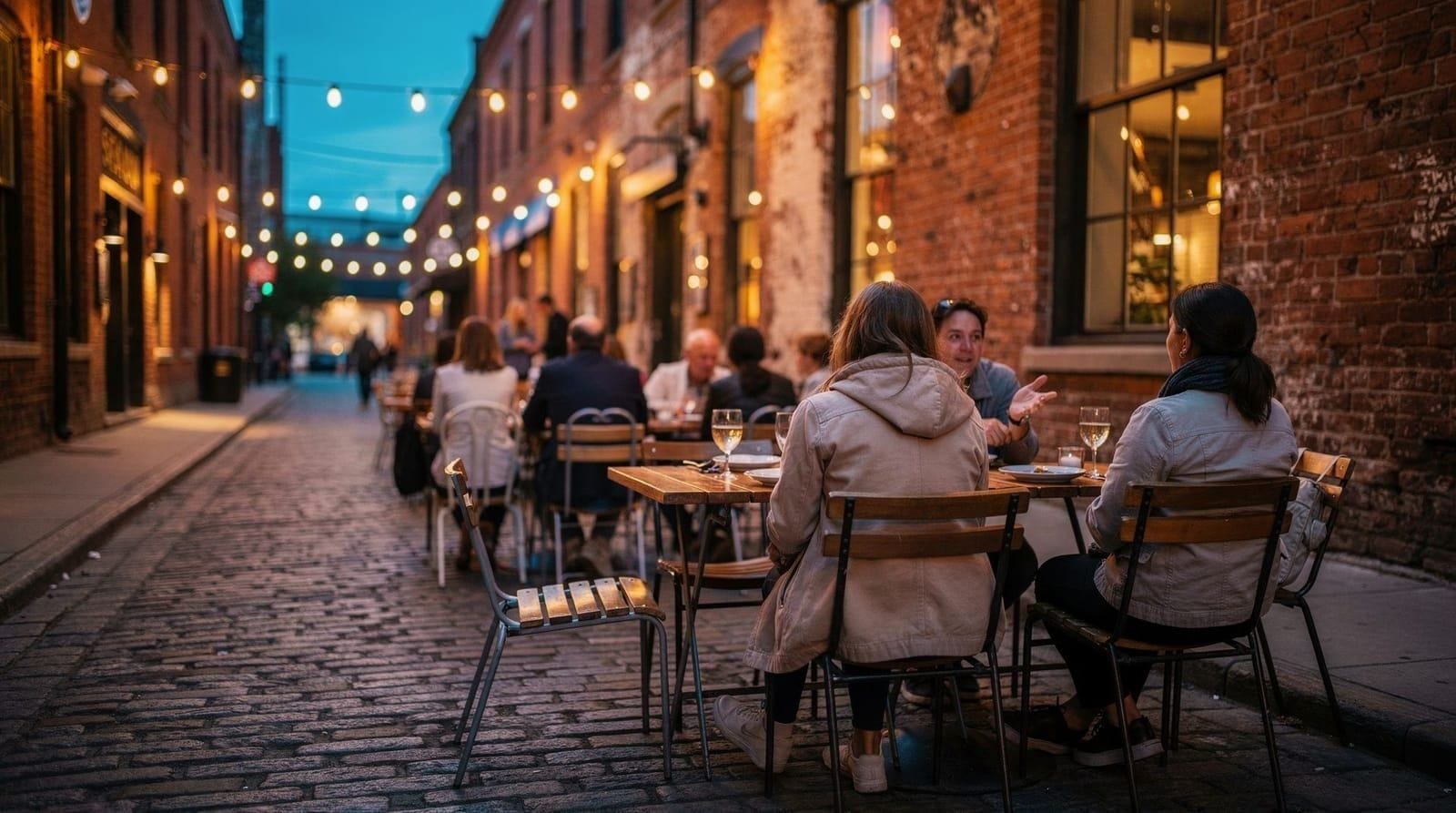
The district’s restaurant scene skews toward destination dining rather than quick bites — this isn’t a food-hall neighborhood like St. Lawrence Market. Expect $30-50 CAD ($22-37 USD) per person for a proper sit-down lunch or dinner at most of the district’s restaurants, with Mill Street’s pub menu running slightly cheaper. For a lighter visit, grab a coffee from Balzac’s and a pastry, then walk the lanes rather than committing to a full meal — you can always eat at nearby St. Lawrence Market or head into the Financial District for more variety and lower prices. Our best restaurants in the Distillery District guide has the full rundown.
When to go
Summer weekends bring the biggest crowds, especially Saturday afternoons when patios fill and the district’s public art installations (rotating seasonal sculptures near the main square) draw photographers. Weekday mornings are close to empty and the best time for photos without people in every frame — useful if you’re also trying to spot a film shoot, which happen frequently on weekdays when the district partially closes to the public for production.
The Distillery District’s Christmas Market, running through November and December, is one of the most popular seasonal events in the city — string lights strung across every lane, a market village of vendor huts, mulled wine, and a towering illuminated ornament. It gets genuinely packed on weekend evenings, so if you want to see it without shoulder-to-shoulder crowds, go on a weekday or right when it opens.
Getting there
The district sits southeast of downtown, bordered by Parliament Street, Mill Street, Cherry Street, and the rail corridor. From Union Station it’s a flat 20-minute walk east along the waterfront trail, passing through the St. Lawrence neighborhood. The 504 King streetcar stops at Parliament Street, a five-minute walk from the main entrance, and it’s the easiest transit option if you don’t want to walk the full distance. There’s no dedicated visitor parking lot directly on-site; the nearest paid lots are on Mill Street and Trinity Street, and they fill quickly on weekends.
Pairing it with the rest of your visit
The Distillery District sits within easy walking distance of St. Lawrence Market (about 15 minutes northwest) and Corktown, making it easy to combine into a single half-day loop through Toronto’s oldest neighborhoods. Our downtown Toronto walking guide includes a route that threads the Financial District, St. Lawrence Market, and the Distillery District together without doubling back.
If you’re interested in the deeper industrial history — the Gooderham family, the fire that nearly ended the site, the film industry’s adoption of the location — our Distillery District history guide goes further into the archival detail than this practical overview.
For a food-focused version of the same neighborhood, check the best restaurants in the Distillery District guide, and if you’re building out a longer Toronto stay, our best Toronto neighborhoods to stay guide compares staying near the Distillery District against downtown and Yorkville hotel clusters. Travelers timing a trip around TIFF should also note the district gets a spillover crowd during festival week, since several afterparty venues operate out of its restaurants — more on that in our TIFF Toronto guide.
The Gooderham and Worts story
The distillery’s name comes from two English immigrants and brothers-in-law, William Gooderham and James Worts, who arrived in Toronto in 1831 and first built a windmill near the harbour to grind flour. Worts died in 1834, drowning in the mill’s grain-elevator well not long after the death of his wife, and Gooderham took over the business alone, gradually shifting from flour milling into distilling as a way to use surplus and unsellable grain — the modest origin of the whisky operation that would eventually eclipse the flour business entirely.
By the time William Gooderham died in 1881, his son George Gooderham had built the company into the largest distillery in the British Empire, producing millions of gallons of spirits annually and making the Gooderham family one of the wealthiest in Canada. George’s fortune is still visible elsewhere in Toronto: he commissioned the flatiron-shaped Gooderham Building at Front and Wellington Streets in 1892, one of the city’s most photographed heritage buildings, built with the same family money though physically unconnected to the distillery site itself.
A serious fire tore through part of the complex in 1869, destroying an earlier stone distillery building, but rather than closing the operation, the company rebuilt on an even larger scale — several of the red-brick buildings standing in the district today date from that post-fire reconstruction, built specifically to be more fire-resistant than what came before. Production continued through the following century under different ownership, including a stretch as one of Canada’s largest spirits exporters during American Prohibition in the 1920s, when Canadian distilleries legally shipped whisky that frequently ended up smuggled across the Great Lakes into the United States.
Distilling on the site finally ended in the mid-20th century, and after the buildings sat empty for years, a development partnership acquired the 13-acre property in 2001 with a specific mandate to restore rather than demolish — an unusual approach at the time for an industrial site this close to downtown.
The restoration preserved original brick, timber framing, and even some machinery as decorative elements rather than replacing them with modern materials, which is a large part of why the district still reads as genuine industrial architecture rather than a themed reconstruction built to look old. The Gooderham name persists today mostly in the district’s branding and in the flatiron building downtown, even though no distilling has happened on-site since before the district reopened to the public in 2003.
The site’s surviving buildings were formally designated a National Historic Site of Canada in 1988, well before the pedestrian district reopened — a distinction that protected the buildings’ exteriors from demolition or significant alteration even during the years the property sat vacant and its future was uncertain. That heritage protection is a big part of why the eventual redevelopment took the adaptive-reuse route rather than the more common Toronto pattern of demolishing an old industrial site and building condo towers on the footprint; developers were legally required to work within the existing shells rather than replace them, which shaped the character of what exists today as much as any single design choice did.
It also explains a detail easy to miss on a casual walk: many of the district’s lane names — Tank House Lane, Case Goods Lane — refer directly to the buildings’ original industrial functions rather than being invented for atmosphere. Tank House Lane ran past the tank house where spirits were stored and blended; Case Goods Lane served the warehouse where bottled product was packed into wooden cases for shipping. Reading the lane names as you walk is a small, free way to understand the site’s original layout without needing a guide.
Practical notes
- Hours: The public lanes are open 24/7, but individual shops typically run 10am-7pm and restaurants later. There’s no admission fee or gate.
- Accessibility: The cobblestone streets are original and uneven in places — manageable for most visitors but slower going for wheelchairs or strollers than a paved district would be.
- Photography: Permitted throughout except when a film production has closed a section, which is marked with signage and, occasionally, a friendly production assistant redirecting foot traffic.
- Bathrooms: Available inside Mill Street Brewery and most sit-down restaurants for customers; a public washroom is also located near the visitor kiosk.
The Distillery District works well as either a standalone half-day outing or a 90-minute add-on to a longer downtown walk — it’s compact enough not to demand a full day, but detailed enough to reward slowing down.
Seasonal art installations and public programming
Beyond the Christmas Market, the district runs a rotating calendar of public art installations and small festivals across the year, often centered on the main square near Trinity Street. These change often enough that it’s worth checking current listings before your trip if a specific installation or event drew you to visit, since what’s on display in summer is rarely the same as what’s there the following spring. The district’s ownership group has leaned increasingly into these temporary installations as a way to give repeat visitors and locals a reason to keep coming back beyond the fixed shops and restaurants, which is worth knowing if you’re a returning visitor wondering whether a second trip is worthwhile.
Spotting a film shoot without getting in the way
Because the district is such a popular filming backdrop, it’s worth knowing the etiquette if you happen to visit on a shoot day. Closed sections are marked with visible signage and usually a production assistant directing foot traffic around the perimeter — walk the alternate route rather than trying to peek past the barrier, since productions can and do pause if visitors wander into frame.
Shoots are more common on weekdays than weekends, since weekend crowds make filming harder to manage, so a weekday visit slightly raises your odds of seeing equipment or a closed lane, even if it also raises the odds of a section being off-limits. If seeing a working film set is part of the appeal, ask staff at the visitor kiosk whether anything is scheduled that day — they generally know, even if they can’t share production details.
Distillery District beer and cheese tasting tourFrequently asked questions about the Distillery District
Is the Distillery District free to visit?
Yes, walking the district and browsing the shops and public art costs nothing. You only pay for what you eat, drink, or buy — restaurant meals, brewery tastings, or gallery pieces — so it’s easy to build a short, no-spend stop into a longer downtown day.
How much time do you need for the Distillery District?
Ninety minutes covers a relaxed walk through the main lanes and a coffee stop. Add another hour if you plan to eat a full meal or browse the galleries and design shops in depth, and budget more during the Christmas Market when the lanes get crowded and slower to move through.
Is the Distillery District walkable from downtown Toronto?
Yes, it’s about a 20-minute walk east from Union Station along the waterfront, or a short ride on the 504 King streetcar to Parliament Street, followed by a five-minute walk. Either route is flat and easy to combine with a stop at St. Lawrence Market along the way.
Why does the Distillery District look familiar from movies?
The intact Victorian industrial architecture makes it a popular stand-in for other cities on film and TV productions — it has appeared in Suicide Squad, Chicago, and dozens of other shoots. Production trucks and closed-set signage are common on weekdays, and occasionally a section of the district closes to the public entirely for a shoot.
Is the Distillery District good for kids?
It’s pleasant but not built around children’s attractions — there are no rides or hands-on exhibits. Families usually pair a short visit with the Toronto Islands or Harbourfront, both a short walk or streetcar ride away, rather than treating it as a standalone kids’ destination.
What’s the best time of year to visit the Distillery District?
Late spring through early fall for patio season, or the Christmas Market in November and December, when the district installs lights, a giant ornament tree, and market stalls. It’s one of the most-visited seasonal events in Toronto and gets crowded on weekend evenings, so a weekday visit is the better trade-off if you want to see it without the biggest crowds.
Can I do a tasting or brewery tour in the Distillery District?
Yes — Mill Street Brewery runs regular beer flights and tastings in its taproom, and guided food-and-drink tours covering beer, cheese, and chocolate stops across several district vendors are also available if you’d rather have a curated route than pick spots yourself.
Is the Distillery District wheelchair accessible?
Partially — the original cobblestones are uneven in places, which slows going for wheelchairs and strollers compared to a paved district, though the lanes themselves are wide and level enough to be navigable with some care.
Top experiences
Bookable activities with verified prices and instant confirmation on GetYourGuide.