Little Italy
Guide to Toronto's Little Italy on College Street: espresso bars, patio culture, the Italian Walk of Fame, and how it differs from Little Portugal next
Toronto Food Tour: The Canuck Culinary Crawl
Quick facts
- Best base for
- Italian food, espresso culture, casual nightlife
- Nearest transit
- 506 College streetcar
- Main strip
- College Street between Bathurst and Grace
- Character
- Post-war Italian immigrant neighbourhood, still active
College Street’s post-war Italian roots
Toronto’s Little Italy grew out of a major wave of Italian immigration in the decades following the Second World War, when College Street between Bathurst Street and Grace Street became the commercial and social hub for a rapidly growing Italian-Canadian community.
Much of that original population has since moved to the suburbs (Woodbridge and other areas north of the city now have larger Italian-Canadian populations than the old neighbourhood itself), but College Street has retained its identity as a dining and gathering strip even as the surrounding streets have diversified. The Italian Walk of Fame, a series of star-shaped plaques set into the sidewalk honouring notable Italian-Canadians, runs along the strip and is worth a slow look if you’re walking rather than driving through.
Espresso culture, still intact
Café Diplomatico, a College Street institution since the 1960s, remains the neighbourhood’s most recognizable espresso bar, with its red-and-white striped awning serving as an unofficial landmark for the whole strip. It’s as much a social hub as a coffee shop — expect regulars who’ve been coming for decades alongside a newer, younger crowd drawn by the atmosphere. The broader strip has a genuine density of proper Italian espresso bars, a different experience from the specialty third-wave coffee shops that dominate elsewhere in the city.
Food beyond the classics
While Italian restaurants remain the anchor, College Street’s food scene has diversified considerably over the past two decades, and today it’s genuinely one of the more varied dining strips in the city rather than a single-cuisine destination. If you want a curated route through the mix rather than guessing block by block, a Canadian culinary crawl covers several stops along the strip, or the fusion fare food tour leans into the neighbourhood’s broader, more mixed culinary identity rather than sticking strictly to Italian classics.
Patio season and World Cup energy
College Street’s patios are a defining summer feature — restaurants and cafés spill tables onto the sidewalk from roughly May through September, and the strip has a long-standing reputation as one of the city’s best neighbourhoods to watch a major soccer match with a genuinely invested crowd. That reputation will matter more than usual during the FIFA World Cup in June-July 2026, when BMO Field hosts matches and Little Italy’s patios are likely to be among the busiest, loudest viewing spots in the city on match days, World Cup history in Toronto’s Italian community running deep from past tournaments.
How Little Italy compares to other Little Italys
Visitors familiar with Little Italy neighbourhoods in cities like New York or Montreal sometimes arrive expecting a similarly dense, tourist-oriented enclave, and the honest comparison is that Toronto’s version is smaller and more locally-oriented, without the same volume of souvenir shops or tour-bus traffic. It reads closer to a genuine neighbourhood commercial strip that happens to have a strong Italian identity than a themed destination built primarily for visitors — part of what makes it a worthwhile stop for anyone who prefers a lower-key, more residential feel over a heavily curated experience.
Corso Italia, the other Little Italy
Confusingly, College Street isn’t the only Italian-identified strip in the city — St. Clair Avenue West, further north, carries the name Corso Italia and has its own, somewhat less nightlife-driven concentration of Italian restaurants, bakeries, and social clubs, reflecting a slightly later wave of Italian-Canadian settlement than the College Street area. It’s not covered in depth here since it sits outside the core visitor circuit, but worth knowing the name if a local mentions it, since the two are genuinely distinct strips rather than the same neighbourhood under two names.
Little Portugal, next door
Immediately west of Little Italy, past Grace Street, the neighbourhood transitions into Little Portugal, centred more around Dundas Street West than College. The two communities’ histories and immigration waves overlap in period but not entirely in geography, and while some visitors treat them as a single stretch, they have distinct identities worth knowing apart — Little Portugal leans more toward Portuguese bakeries, grill restaurants, and a slightly different, somewhat less nightlife-dense character than College Street’s Little Italy strip.
Getting there
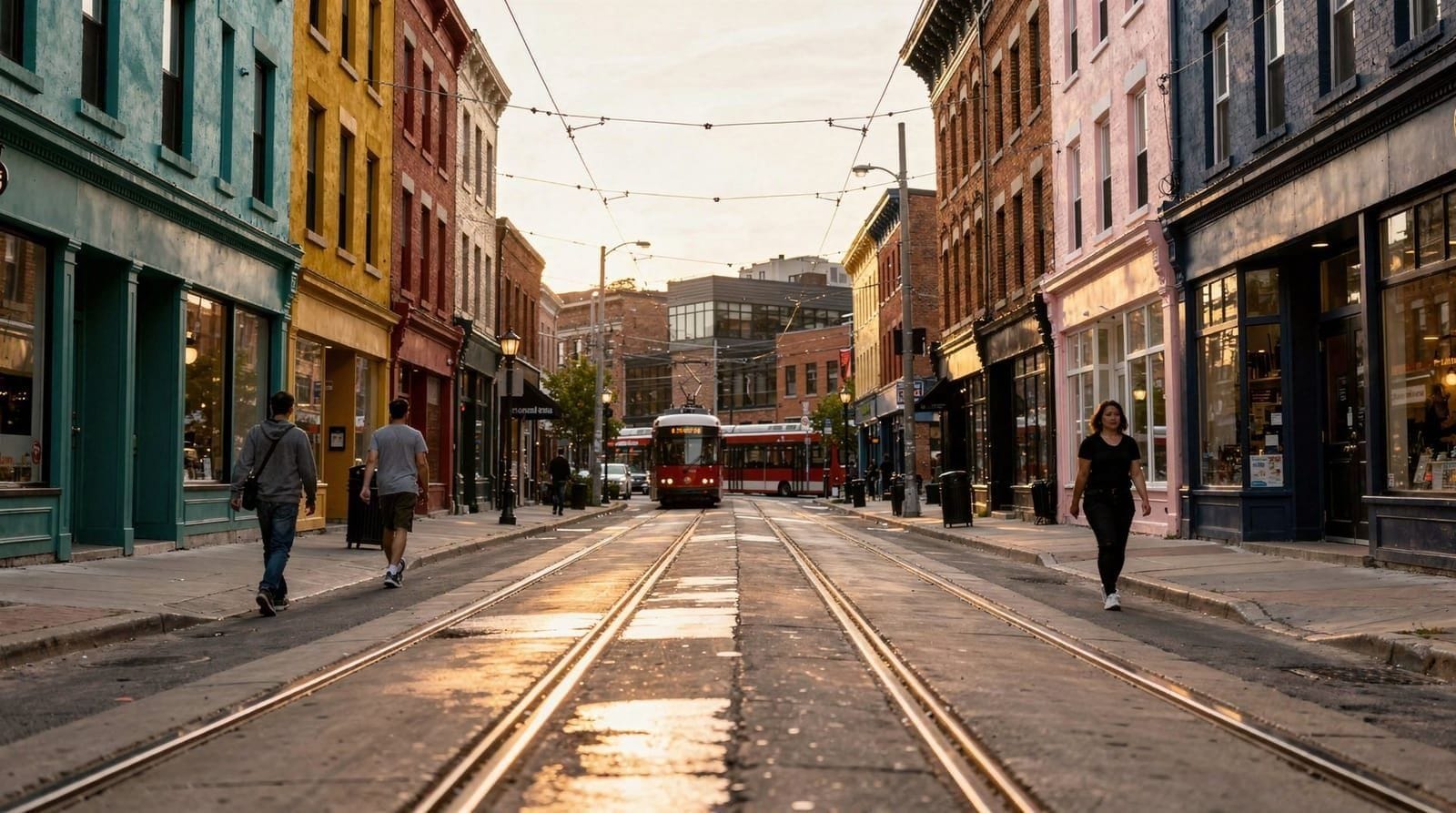
The 506 College streetcar runs the length of the strip and connects to both the University-Spadina and Bathurst subway lines at their respective crossings, making Little Italy straightforward to reach without a car. From Kensington Market, it’s a comfortable 15-20 minute walk north, making the two a natural pairing for an afternoon-into-evening outing.
Best time to visit
Late spring through summer (May-September) is when Little Italy is at its best, with the patio culture in full swing and warm evenings drawing crowds onto the sidewalks well past dark. The neighbourhood quiets down considerably in winter, when the outdoor seating disappears and much of the strip’s appeal (which leans heavily on the outdoor, social atmosphere) diminishes accordingly — indoor dining remains solid, but the defining character of the neighbourhood is muted.
A sample evening route
Arrive by early evening and start with an espresso or aperitivo at Café Diplomatico to get oriented on the strip. Walk the full stretch of College between Bathurst and Grace, reading the Italian Walk of Fame plaques and checking a few restaurant menus posted outside before settling on dinner. Finish the night with a gelato or another coffee, timing your visit for a warm evening if possible, since the patio culture is genuinely the neighbourhood’s defining feature and much of the appeal is muted indoors.
Nightlife beyond dinner
Little Italy’s evening scene extends past dinner service into a genuine, if lower-key, bar and lounge culture along College Street, distinct from the louder, younger crowd you’d find in the Entertainment District. Several venues lean into the neighbourhood’s soccer-viewing reputation with big screens for major matches, worth seeking out specifically if you want the atmosphere described earlier around World Cup viewing extended to a regular-season match or another sport entirely.
Practical tips
Reservations matter more here on weekend evenings than the neighbourhood’s casual reputation might suggest, particularly at the more established Italian restaurants. If you’re coming specifically for the World Cup viewing atmosphere in 2026, expect the strip to be genuinely packed on Canada’s or a heavily supported team’s match days — arrive early if you want an actual seat rather than standing room. Parking is limited and street-metered; the streetcar or a short walk from a subway connection is the more practical option.
The neighbourhood’s role in Toronto’s broader immigration mosaic
Little Italy is one of several ethnic-heritage commercial strips that emerged across Toronto through the mid-20th century as different immigrant communities established themselves in specific pockets of the city — Chinatown, Little Portugal, Greektown on the Danforth, and Corso Italia further north all followed a broadly similar pattern of a community settling, opening businesses, and gradually seeing the surrounding residential population diversify even as the commercial identity persisted.
Understanding College Street’s Little Italy within this wider context helps explain why so many of the city’s neighbourhood names still reference a specific immigrant heritage even decades after the original community has largely dispersed to the suburbs — the commercial and cultural identity outlasted the residential concentration in nearly every case.
Combining Little Italy with a full west-end day
Given its position relative to Kensington Market and Queen West, Little Italy works well as the final stop on a longer west-end day rather than a starting point — its evening-oriented patio and dinner culture suits arriving here after an afternoon spent shopping and wandering elsewhere, rather than trying to fit a full Little Italy visit into an already busy morning.
Grocery shopping for Italian specialty goods
Beyond restaurants, College Street retains a handful of specialty Italian grocers selling imported pasta, olive oil, cured meats, and cheese — a useful stop if you’re self-catering during your stay or simply want to browse ingredients rather than eat out. These shops tend to keep more traditional daytime hours than the strip’s restaurants and bars, so plan a morning or early-afternoon visit if grocery browsing specifically is on your list.
A final note on timing your visit
Because so much of Little Italy’s appeal depends on outdoor patio weather, visitors travelling in the shoulder or winter months should adjust expectations accordingly — the restaurants and cafés remain fully open and worth visiting, but the specific, much-discussed atmosphere of a warm summer evening on College Street simply isn’t replicable indoors in February.
Comparing Little Italy to nearby Koreatown
Just north of College Street, Bloor Street between Bathurst and Christie Street is home to Toronto’s Koreatown, another dense ethnic-commercial strip worth knowing about if you’re already in the area. The two neighbourhoods have distinct identities and are worth treating as separate stops rather than assuming proximity means overlap — Koreatown’s Korean barbecue restaurants and karaoke bars offer a genuinely different evening than College Street’s Italian patio scene.
Budgeting an evening on College Street
A sit-down Italian dinner for two with wine typically runs C$70-110 depending on the restaurant, while an espresso and pastry at Café Diplomatico is closer to C$8-12. Combining a food tour like the Canadian culinary crawl with a later, self-directed dinner stop is a reasonable way to sample several kitchens on the strip without committing your whole budget to one restaurant.
A note on reservations during major events
If your visit coincides with a major soccer tournament, a significant Maple Leafs or Raptors playoff run, or another citywide sporting event, book restaurant reservations on College Street well ahead of the date. The strip’s reputation as a viewing destination means tables disappear quickly once a match date is announced, more so than the neighbourhood’s generally casual reputation might suggest.
One more practical detail
Street parking along College Street is metered and limited during business hours, and enforcement is active — factor this in if you’re driving rather than taking the streetcar, since a parking ticket can easily erase any time saved over public transit for a short visit.
Frequently asked questions about Little Italy
Is Little Italy still mostly Italian?
The neighbourhood’s Italian-Canadian population has largely moved to the suburbs over the decades, but College Street retains a strong Italian dining and cultural identity, reinforced by the restaurants, cafés, and the Italian Walk of Fame along the strip.
What’s the difference between Little Italy and Little Portugal?
Little Italy centres on College Street between Bathurst and Grace; Little Portugal sits just west, centred more on Dundas Street West, with a distinct Portuguese-focused dining and cultural identity.
How do I get to Little Italy from downtown?
The 506 College streetcar runs directly along the strip; from downtown, the most direct route is via the University-Spadina subway line to a College Street crossing, then the streetcar west.
Is Little Italy good for a soccer-watching atmosphere?
Yes, it has a long-standing reputation as one of the city’s best neighbourhoods for watching major soccer matches, an atmosphere expected to intensify significantly during the FIFA World Cup in June-July 2026.
Is Little Italy walkable from Kensington Market?
Yes, it’s a comfortable 15-20 minute walk north from Kensington Market, making the two neighbourhoods a natural same-day pairing.
Does Little Italy have good coffee?
Yes, the strip has a genuine concentration of long-running Italian espresso bars, led by the long-standing Café Diplomatico, distinct from the specialty coffee shops found elsewhere in the city.
Top experiences
Bookable activities with verified prices and instant confirmation on GetYourGuide.